The strange thing about history is that is not really about the past.
It’s about the stories we tell ourselves to help us explain our present and shape our future: how we got here and where we are going.
That’s why in the 21st century we are witnessing two of the most powerful men in the world trying to erase uncomfortable historical truths from decades or even centuries ago in order to justify their actions today.
As Russian President Vladimir Putin strengthened his totalitarian grip on his country, authorities closed Moscow’s Gulag History Museum, which documented the crimes of the Soviet dictator Joseph Stalin.
For his part, U.S. President Donald Trump – determined to reshape America in his own image – has been on the warpath to rewrite that country’s history, especially as it comes to slavery.
He too has targeted museums, complaining in one of his many social media posts that the famed Smithsonian Institution is “OUT OF CONTROL, where everything discussed is how horrible our Country is, how bad Slavery was.”
Within weeks of returning to power in 2025, Mr. Trump issued an executive order called “Restoring Truth and Sanity to American History” – obliging all public monuments, memorials and statues not to display anything that “inappropriately disparage Americans past or living.”
A statue in Washington, D.C., honouring a Confederate general – the only one of its kind in the American capital – was reinstalled a few months later, following a second executive order that called for the restoration of monuments and statues.
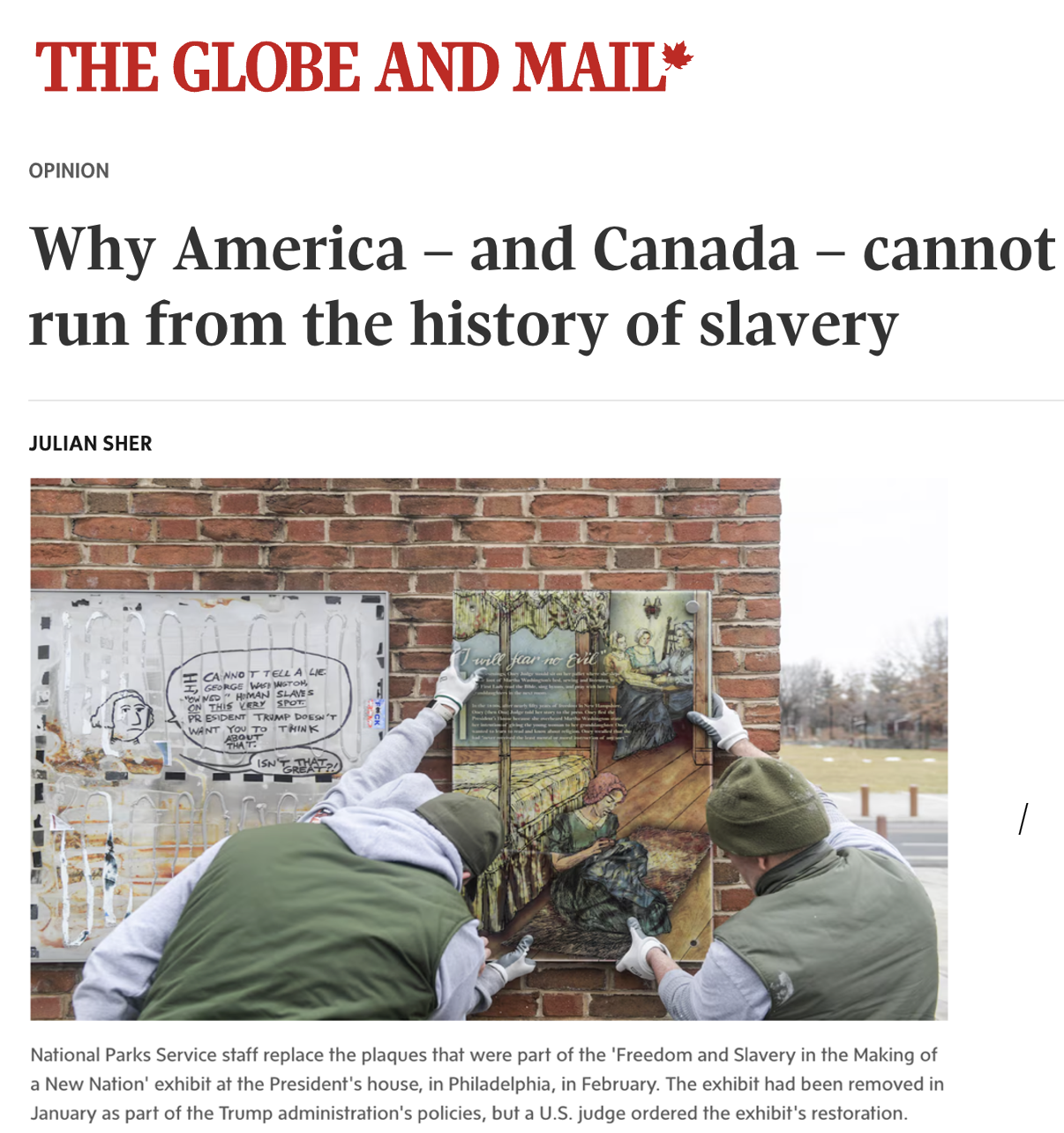
In early 2026, a plaque memorializing nine people enslaved by George Washington was removed from a site where the first American president once lived. A new plaque references slavery, but is less unequivocal about its evils.
Last month, a U.S. federal appeals court ruled that the Trump administration could continue removing these signs and exhibits about slavery across the country, reversing a lower court’s earlier decision.
The problem with this whitewashing – has the colour of that word ever been more appropriate? – is not only that it is full of lies. These lies can be dangerous, for we ignore the lessons of history at our peril.
The lower court judge who originally blocked Mr. Trump’s order noted that plaques and exhibits about slavery reflect the “multilayered history of our nation, including the good, the bad and the ugly.”
Precisely.
You need to understand the bad and the ugly to fight your way to the good.
When you visit your doctor, do you want him to tell you about a cancer that was discovered in your body so you can try to cure it, or would you prefer he cover it up and lie about it?
That’s the analogy used by Bryan Stevenson, a civil rights lawyer who heads the Equal Justice Initiative and helped set up a National Memorial for Peace and Justice in Montgomery, Ala., to honour the thousands of Black victims of racial lynching.
He is not disparaging his country; he wants to make it better by forcing a reckoning with its past.
Marsha Lederman: Welcome to the slavery memorial. Enjoy the beautiful view
Canada is not immune from the reluctance to face up to the dark corners of our history.
In northwest Toronto near the former Downsview Airport, there is a Canadian Armed Forces facility where reserve units meet and train. It is officially called the Lieutenant-Colonel George Taylor Denison III Armoury, named after a wealthy aristocrat of the late 19th century.
“The third generation of a prominent Toronto family, Denison commanded a local cavalry regiment and [was also] active in politics,” a plaque in the main entrance reads.
Well, yes – but what kind of politics?
When the American Civil War erupted in 1861, Denison – a wealthy landowner and later a city councillor and judge – openly and proudly sympathized with the slave-owning Southern aristocrats.
The Confederacy set up a secret service to operate in Canada and carry out sabotage and terror attacks against the Union. Denison boasted in his memoirs that “I was a strong friend” to these Confederate agents. He welcomed them in his luxurious villa on a sprawling estate west of the city.
A police raid at the house of one of Denison’s accomplices in Toronto turned up 26 torpedoes floating in the water of the cellar. The screaming New York Times headline read: “An Armed Expedition Ready to sail from Toronto ... A TORONTO COUNCILMAN IMPLICATED.”
Denison was not out of step with many of Canada’s elites at the time: newspaper editors, church leaders, bankers and politicians in various ways lent support to the South – a sad truth not highlighted in our history books or museums today.
Why should our military not find a way instead to honour Alexander Ruffin Abbott, the first Canadian-born Black doctor, who took the opposite path chosen by Denison? He served as a surgeon in Lincoln’s Union Army to put an end to slavery and never stopped fighting racism when he returned to Canada.
A plaque detailing his pathbreaking contributions was installed in 2023 not far from the University of Toronto, where Abbott studied, thanks in part to the efforts of Dr. Nav Persaud.
The smallest tributes to our historical truths help.
In the late 18th century, when slavery was still widespread in Canada, Marie-Josèphe Angélique, an enslaved woman accused of arson when she tried to flee her bondage, was tortured into a confession, hanged, and then burned in front of Montreal’s Notre Dame Basilica.
Just steps from where she was executed, a square now bears her name after the city voted to herald her legacy. A stamp was also issued by Canada Post to commemorate her in 2025.
America is trying to bury its ugly past. We are making tentative steps to unbury it.
“The past isn’t dead and buried. In fact, it isn’t even past,” a little-known senator running for the U.S. presidency once said. Barack Obama paraphrased those words from famed Southern writer William Faulkner in a widely covered address he made in March, 2008. He titled his speech “A More Perfect Union,” invoking the dream of Abraham Lincoln, another president who, unlike Mr. Trump, was not afraid of confronting the demons of his country’s past.
He understood that you cannot know where you are going if you don’t know where you have been.
Hiding the past is a dangerous way to travel.
_______
Julian Sher is an investigative journalist based in Montreal and author of The North Star: Canada and the Civil War Plots Against Lincoln.
Read the original online story here: https://www.theglobeandmail.com/gift/116e4c53a70f25bc144bf1397d46a6e34f3274413b904e305231a637d75abbe0/XUZXH6WTWJAO5LAKSRGDVP4AV4/